Do-Along STEM · Book 4
Noor and the Zip-Line Rocket
A Do-Along STEM Book About Push and Push-Back
Meet the job Aerospace engineer
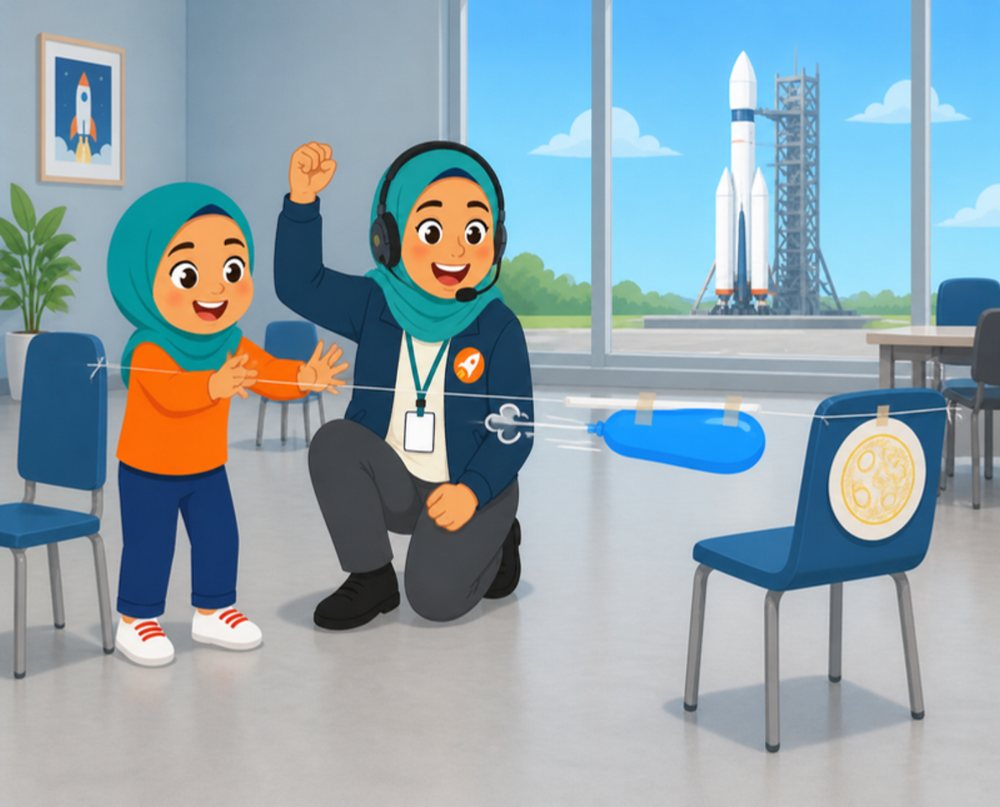
It’s launch day at Auntie’s rocket center, but the wind is too strong up high, so the launch is on hold. While they wait, Noor and Auntie build a rocket of their own: a long balloon that has to reach a paper Moon across the room. Rocket 1 went everywhere, everywhere except the Moon. Rocket 2, on a droopy string, got stuck halfway. Then Noor pulls the string tight and finds out what aerospace engineers know: push one way, zoom the other!
Coming soon on Amazon Play Moon Mission
Get the book
-
The paperback
The printed book is coming soon on Amazon.
Coming soon on Amazon -
Printable rocket test sheet
The rocket test sheet from page 31 to fill in, and Mission Control’s cheat sheet for grown-ups.
Download
What you need
- Long balloons (round ones work too), and a balloon pump if you have one
- A long, smooth string that reaches across the room: fishing line, kite string or dental floss
- A straight drinking straw (not a bendy one) and tape
- Two chairs, paper, a marker and scissors
- Sticky notes, to mark where each rocket stops
Time: 20 to 30 minutesMess: noneAges: 5 to 8
Your job: be Mission Control
- You blow up the balloons, or use a pump. Balloons never go in children’s mouths.
- Point the balloon’s open end away from faces. Clear the path before every launch.
- Pick up any broken balloon pieces at once.
- No running near the zip line. Take it down when you’re done.
Reading with a class? You are Mission Control. Hang one zip line across the front of the room and launch the rockets while the class counts down, guesses and marks where each one stops. Balloons are a choking risk for children under 8, so keep them in grown-up hands.
Peek inside
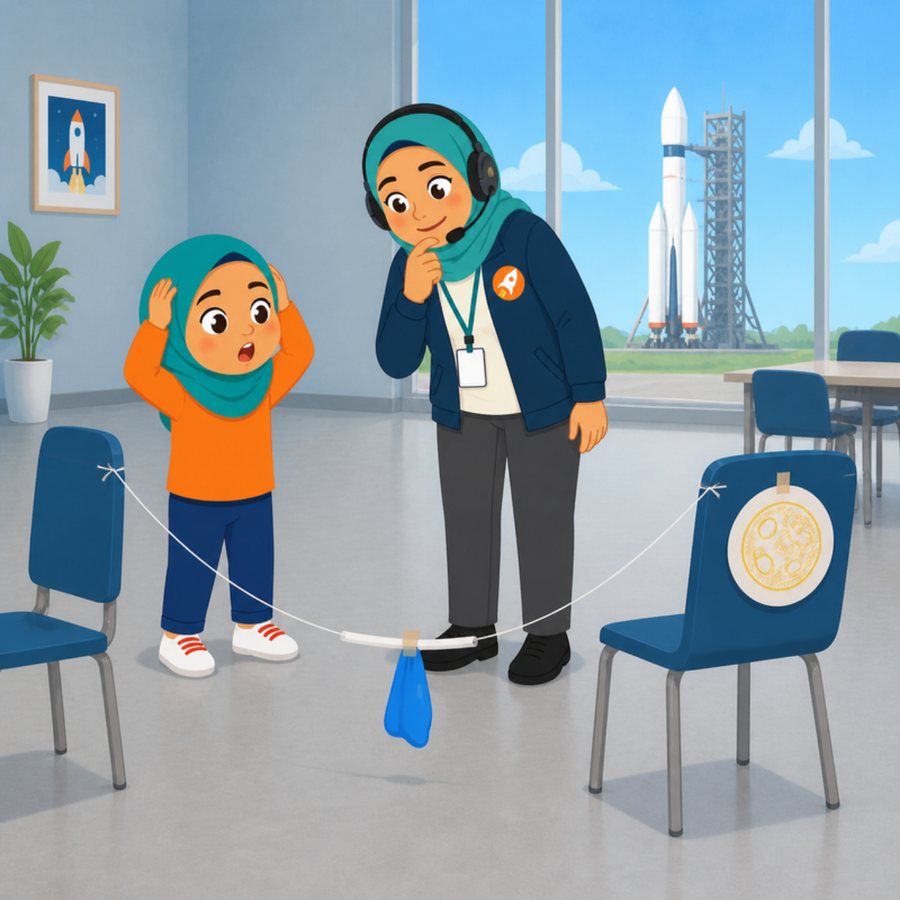
Rocket 2 on a droopy string: ZZZIP... slower... slower... stuck halfway, right in the droopy middle.
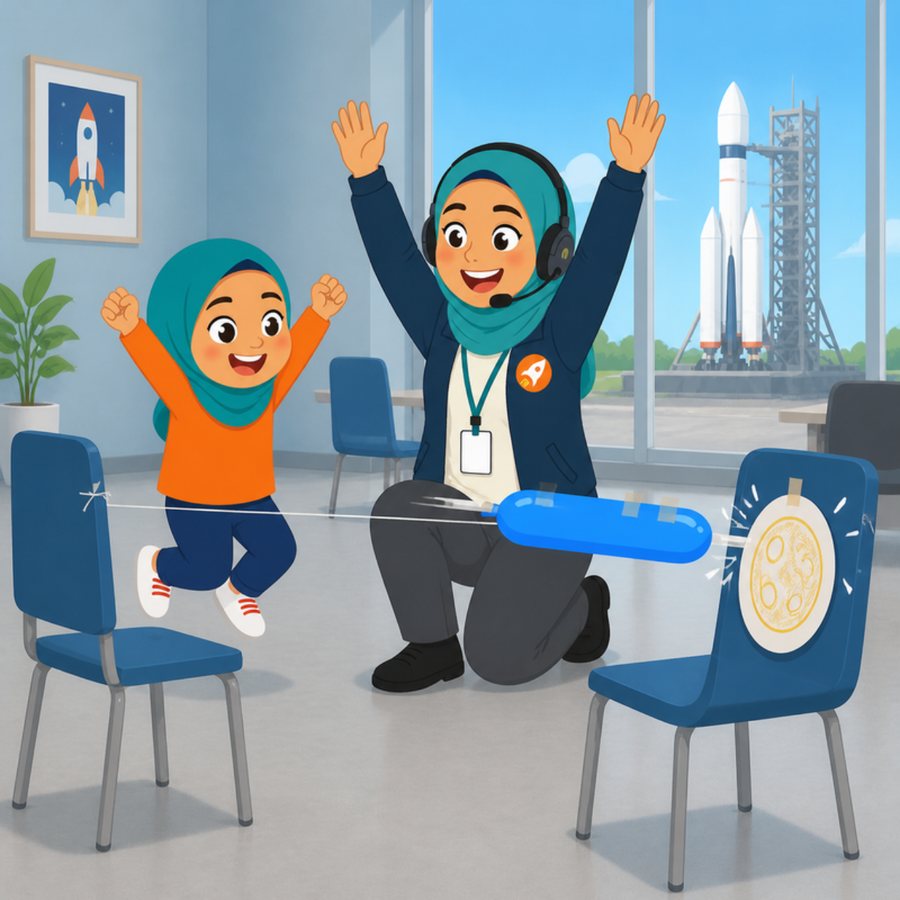
A fresh balloon and a tight string. ZZZZZZIP! BONK! It hit the Moon!
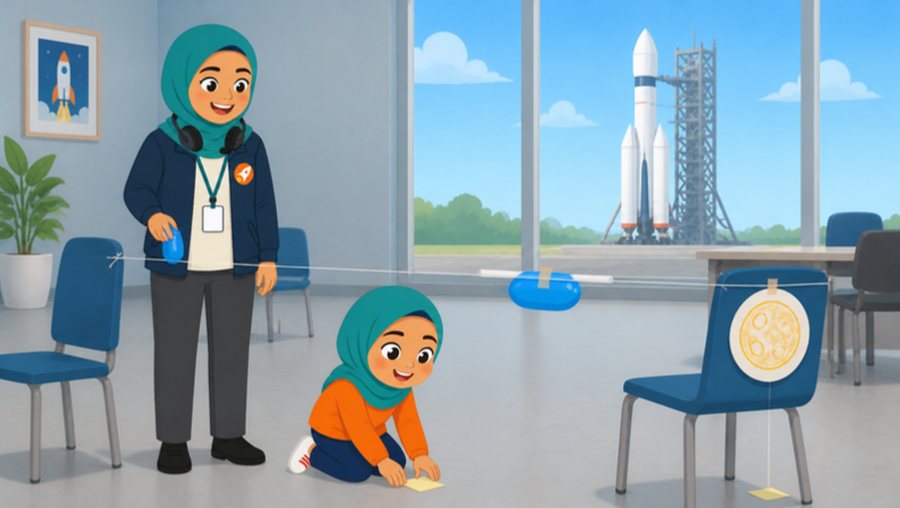
The same tight string and only half the air. Rocket 4 stops partway. Bigger push, farther zoom!

Fire and smoke blast down, and Auntie’s rocket rises up. Push one way, zoom the other!

Play Moon Mission
After the book, children can launch Noor’s balloon rockets on screen. Mission Control checks that the path is clear, then children pick a string and a push, guess where the rocket will go, count down and let go. Every launch goes into the mission log and the "How far did it go?" chart, Paper Noor can ride along, and when she lands on the Moon, Auntie’s real rocket is GO for launch.
Works on tablets, phones and computers. Nothing to install, nothing to sign up for. The game’s rockets stop where Noor’s did. A real balloon rocket will stop in its own place, so test yours too.
For teachers
This book supports these kindergarten science standards, and builds toward a middle school one:
- K-PS2-1 Test how pushes of different strengths or directions change the way an object moves.
- K-PS2-2 Use test results to decide if a design works as intended to change an object’s speed or direction with a push.
- MS-PS2-1 Middle school: use Newton’s third law (every push has an equal push back) to design a solution.
What do aerospace engineers do?
They design and test things that fly, from airplanes to rockets. They make sure each one has the right push and stays on the right path. Just like you did.
Did you know? In 1920, a newspaper said rockets could never fly in space, because there is no air to push on. In 1969, as astronauts flew to the Moon, it said sorry! Source: NASA History: 95 Years Ago, Goddard’s First Liquid-Fueled Rocket
Story and activities: Dr. Shane Wines.